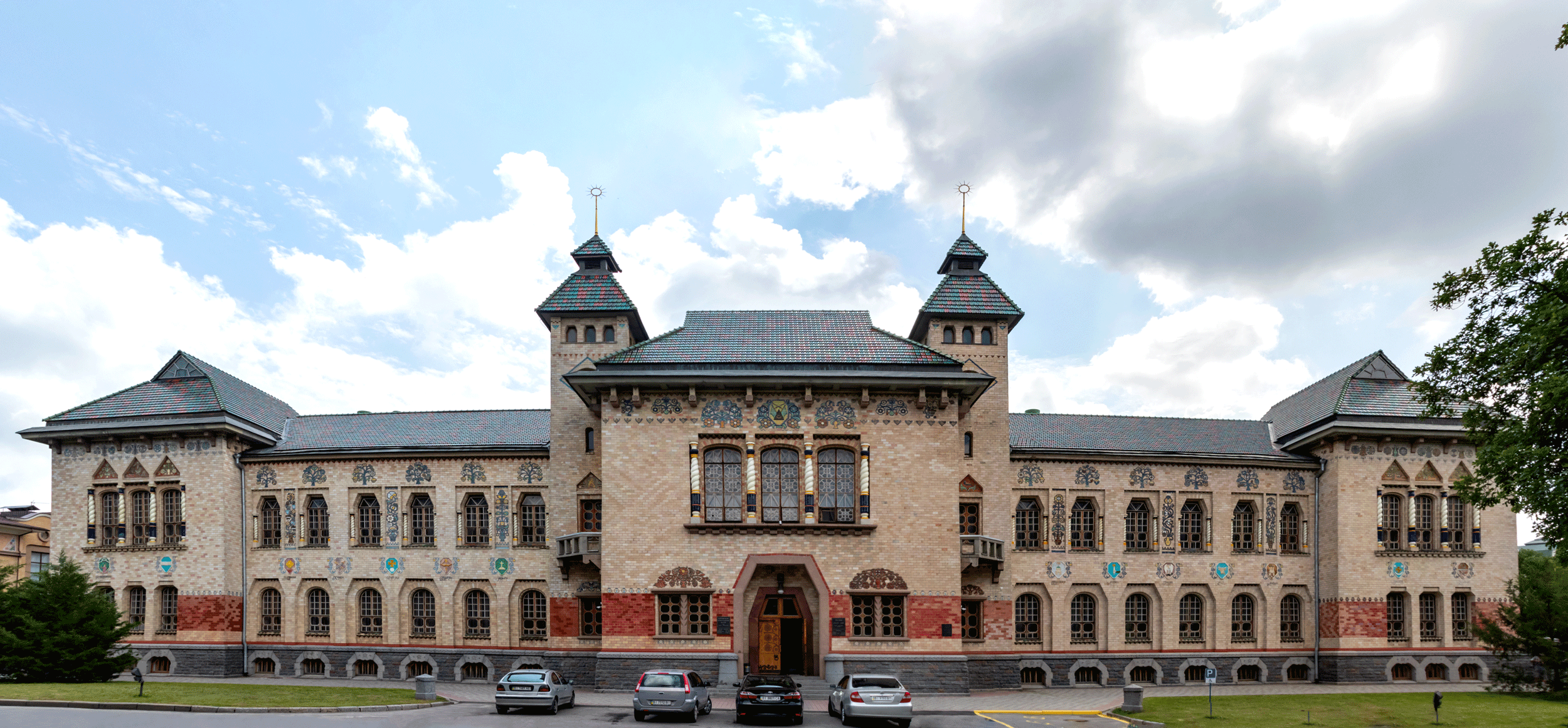
In a picturesque corner of the historic centre of Poltava stands a monumental building — the former Poltava Huberniina Zemstvo House, now home to the Vasyl Krychevsky Poltava Local Lore Museum. The institution was founded in 1891 as the Natural History Museum of the Poltava Huberniia Zemstvo. Behind its magnificent façade lies a fascinating history of how the private initiative of the soil scientist Vasyl Dokuchaiev, supported by progressive zemstvo activists and developed by museum professionals and generous patrons from the late 19th through the 20th century, transformed the institution into one of the principal repositories of cultural heritage on the Left Bank of Ukraine.
Thanks to the painstaking work of many generations, the Vasyl Krychevsky Poltava Local Lore Museum is experiencing a new period of renewal today. Its collections comprise approximately 300,000 objects, including archaeological finds, ethnographic rarities, artefacts from the Kyivan Rus and Cossack periods, weapons and military artefacts, numismatic and faleristic collections, documents and photographs, as well as natural history specimens. Among the latter is a mammoth skeleton assembled from bones discovered in the Poltava Region.
In 1906, the patron and educator Kateryna Skarzhynska donated her private collection, assembled in the village of Kruhlyk near Lubny, to the Natural History Museum of the Poltava Huberniia Zemstvo. The donation comprised more than 20,000 objects, as well as a library and archive. Another major contribution came from the benefactor Pavlo Bobrovskyi. Between 1897 and 1917, he purchased unique artefacts at his own expense and donated them to the museum. His gifts ranged from objects of Ancient Egypt and Ancient Greece to artefacts from the exotic regions of Africa, India, and Indonesia, totalling approximately 3,000 objects.
The museum is not merely a repository of rarities, but also a place of memory and commemoration. During its 135-year history, a distinguished group of scholars — Mykhailo Olekhivskyi, Ivan Zaretskyi, Vadym Shcherbakivskyi, Kost Moshchenko, Mykhailo Rudynskyi, Yakiv Ryzhenko, Oleksandr Takhtai, Mykola Havrylenko, and many others — contributed through their dedicated work to the development and flourishing of the institution despite financial constraints, revolutions, wars, and political repression.
The building that houses the museum has itself become its “principal exhibit”. Designed by the distinguished artist Vasyl Krychevsky in the Ukrainian Architectural Modern style, with colourful ceramic tiles and majolica on the façade and murals by Serhii Vasylkivskyi and Mykola Samokysh inside, it is a remarkable palace of art and craftsmanship. Conceived for the public in a richly colourful and sumptuous yet warm and intimate manner, the building remains an outstanding monument of Ukrainian architecture.
The 20th century brought severe trials for the museum. In 1943, Nazi occupying forces set fire to the looted building. The blaze destroyed tens of thousands of priceless objects, a loss that cannot be fully compensated even today. The historic building was eventually brought back to life: in 1964, through the enormous efforts of architects and scholars, it was completely restored, with its original appearance reconstructed in detail.
The tragedies the museum has endured taught its staff an essential lesson: preserving history is not enough — one must also know how to restore it to life. This responsibility is carried out every day by museum scholars and specialists who build a bridge between the past and the future. At the heart of this work is the museum’s Research and Conservation Department. Its specialists tirelessly rescue unique cultural heritage objects from deterioration, give them a new lease of life, and return them to the exhibition halls.
Today, the Vasyl Krychevsky Poltava Local Lore Museum is not a static repository of antiquities but a dynamic cultural hub, where the classical museum formula of “preservation–research–public education” is taking innovative forms. The digitisation of the collections and the creation of an online collection of 2D and 3D images of museum objects are currently under way. IT specialists are developing an integrated digital environment that brings local cultural artefacts into the global online sphere. The museum’s accessible website offers an immersive VR tour with audio guides, a panoramic 360° video tour, and images of digitised rarities. The museum has also become a venue for a wide range of scholarly and cultural events, including inter-museum projects, exhibitions, conferences, round-table discussions, fairs, volunteer initiatives, workshops, quests, and themed evenings.
Over 135 years of continuous activity, the Vasyl Krychevsky Poltava Local Lore Museum has travelled a complex path marked by challenges and achievements: from the first zemstvo collections and the construction of a masterpiece of Ukrainian Architectural Modern, through the ideological pressures of the 20th century and the ashes of the Second World War, to the challenges of the present-day period of martial law. Museum work continues without interruption. It is a process of constant renewal — the perpetual youth of one of Ukraine’s richest museum collections.